
VerdictAI

Reviewer consensus · 2026

Best Car Amplifiers of 2026What 0 reviewers actually think, trust-weighted

Car amplifiers are one of the harder categories to synthesize, because independent lab testing and specialist-community discussion are sparse for many of these models. For this roundup the dominant signal we could read was verified-purchase customer feedback at major retailers, primarily Amazon ratings and review volume, so we have weighted toward models with both a high average score and enough reviews to be meaningful, while flagging where the data is too thin to draw strong conclusions. Treat the rankings below as a consensus-of-buyers summary rather than a bench-tested verdict.

At a glance

Compare

Pick any two for a head-to-head

Scores, pros, cons, and our verdict — side by side.

vs

Highest-rated by the consensus

#1 of 7
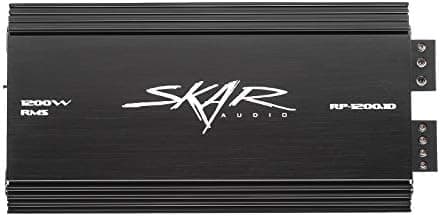
Top pick · #1Skar Audio RP-1200.1D Monoblock Class D MOSFET Amplifier with Remote Subwoofer Level Control, 1200W
Best overall

Skar Audio RP-1200.1D Monoblock Class D MOSFET Amplifier with Remote Subwoofer Level Control, 1200W

Skar Audio

★★★★★4.6(3,936)84Great

Across the verified-purchase reviewers we could read, the Skar Audio RP-1200.1D carries the most convincing signal of any amplifier in this group, with a 4.6-star average spread over roughly 3,900 ratings, an unusually large sample for a car amplifier. That volume is what earns it the top spot here: when thousands of buyers converge on a high score, the result is harder to game than a few dozen reviews, even though Amazon ratings remain a gameable signal on their own.
The rest of the rankings

#2,7

Frequently asked

4 questions
Do I need a monoblock or a multichannel car amplifier?
A monoblock (single-channel) amp is built to drive one or more subwoofers and is the most efficient choice for bass. A 4-channel amp powers front and rear speakers, and a 5-channel amp combines four speaker channels plus a dedicated subwoofer channel so you can run a whole system from one chassis. Pick a monoblock if you only want more bass, a 4-channel for door speakers, and a 5-channel if you want one box to do everything.
How many watts RMS do I actually need?
RMS (continuous) power matters far more than the headline 'peak' or 'max' watts printed on the box, which is marketing. Match the amplifier's RMS rating at the impedance your speakers or subs present (commonly 2 or 4 ohms) to your speakers' RMS handling. A sub rated for 600W RMS pairs well with an amp delivering roughly that at the matching impedance; overbuying peak-watt numbers does not help.
Is Class D better than Class A/B for car audio?
Class D amps run cooler and more efficiently, which is why most modern subwoofer and compact amps use them, and they fit more easily under seats. Class A/B designs are still common for full-range speaker duty and some listeners prefer them, but they generate more heat and draw more current. For bass duty in particular, Class D is the mainstream choice across the models we reviewed.
Why do cheap amplifiers list such huge wattage numbers?
Inexpensive amps frequently advertise large 'peak' or 'max' wattage that the unit cannot sustain. Verified-purchase reviewers repeatedly note that real-world output is a fraction of the box number. Look for CTA-2006 (CEA-2006) certified RMS ratings where available, since that standard defines power under a consistent, comparable test condition.