
VerdictAI

Reviewer consensus · 2026

Best Jumper Cables of 2026What 41 reviewers actually think, trust-weighted

Jumper cables are one of those automotive purchases where the spec sheet matters more than the brand badge: gauge, length, clamp quality, and conductor material drive whether a set actually delivers a start or just heats up. To rank this subcategory we pulled together verified-purchase reviews from major retailers, mainstream tech and auto press, and specialist subreddits like r/VEDC, r/MechanicAdvice, and r/mechanics, then weighted those signals by trust tier. The picks below reflect that synthesis, not first-hand bench testing.

Sources behind this verdict

41 reviewers, weighted by source trust

41reviewers read

Weighted by source trust

We don’t review products. We read what other reviewers wrote, score each source for trustworthiness, and synthesize the consensus.

How sources are scored →

Trust hierarchy

Trusted1
Verified0
Supporting8
Flagged0

Source mix

41signals
  • 21Community
  • 20Video

Trusted · 1 source

Independent · documented methodology

At a glance

Highest-rated by the consensus

#1 of 5
Top pick · #1Energizer Heavy Duty Jumper Cables for Car Battery, Automotive Booster Cables for Jump Starting Dead or Weak…
Best overall

Energizer Heavy Duty Jumper Cables for Car Battery, Automotive Booster Cables for Jump Starting Dead or Weak…

Energizer

★★★★★4.8(32,094)89Great

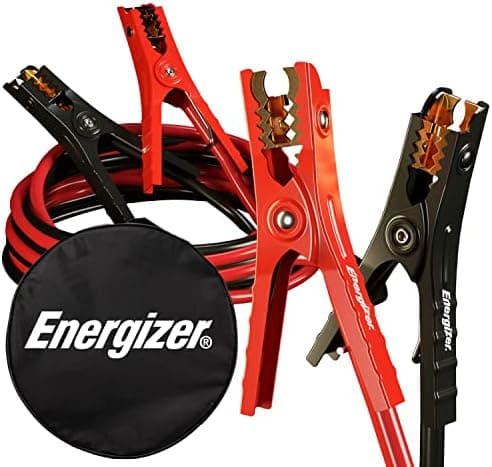
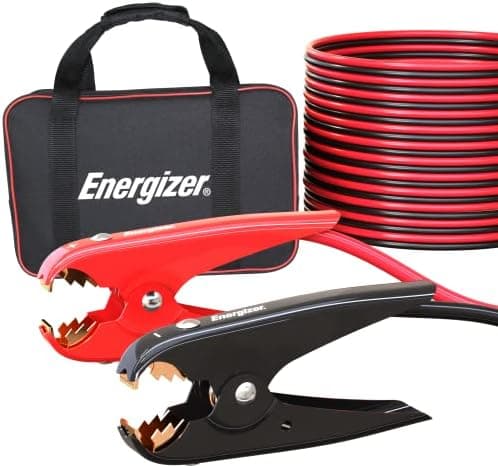
Across the reviewers we read, the Energizer 25-foot 1-gauge set lands as the most broadly recommended general-purpose pick in the candidate pool. The Amazon listing carries more than 32,000 verified-purchase reviews at a 4.8 average, and an AutoZone customer review thread quoted in the signals describes them as 'probably one of the best that I've purchased in recent years.' That's retailer-customer sentiment, not lab testing, but the volume is hard to ignore.

The rest of the rankings

#2,5

Frequently asked

5 questions
What gauge jumper cables do I actually need?
Across the reviewers we read, the rough consensus is 6-gauge for compact cars and short reaches, 4-gauge as a flexible daily-driver default, and 1- or 0-gauge for trucks, diesels, larger SUVs, or when you need to reach across a long distance. Lower AWG numbers mean thicker copper and less voltage drop, which matters more the longer the cable and the larger the engine.
Is copper-clad aluminum (CCA) okay, or do I need pure copper?
Specialist threads in r/VEDC and r/MechanicAdvice consistently note that pure copper conducts better and is more flexible, but a thick CCA cable in a heavier gauge can outperform a thin pure-copper cable in a smaller gauge. Most mass-market consumer cables, including the ones in this roundup, are CCA, and reviewers generally consider them adequate as long as the gauge is appropriate for the vehicle.
How long should jumper cables be?
Reviewers in r/VEDC and r/harborfreight repeatedly point out that 20 feet is the practical minimum if you ever expect to jump nose-to-nose-blocked vehicles, and 25–30 feet is preferred for trucks, parking-lot scenarios, or jumping from behind. Longer cables require thicker gauge to compensate for voltage drop.
Are jumper cables or a portable jump starter the better buy?
Across r/VEDC and r/LifeProTips, the discussion generally lands on owning both: a lithium jump pack for solo emergencies when no donor car is around, and a quality set of cables as a redundant backup that never needs charging. Cables don't go dead in your trunk after a year of neglect.
Why do cheap jumper cables fail to start a car?
Reviewers in r/VEDC and r/MechanicAdvice flag two recurring failures: undersized conductors (sold as 'heavy duty' but actually 8- or 10-gauge under the insulation) and weak clamps that don't bite through corrosion. Both add resistance, and on a deeply discharged battery that resistance is often enough to prevent a start.