
VerdictAI

Reviewer consensus · 2026

Best Camping Kettles of 2026What 40 reviewers actually think, trust-weighted

Camping kettles span a wide range, from sub-5-ounce titanium mugs aimed at thru-hikers to 2L+ aluminum and stainless pots built to feed a group around a fire. The picks below synthesize what specialist backpacking communities, mainstream outdoor publishers, and verified-purchase reviewers at major outdoor retailers have written about each model, weighted by source trust. Where reviewers disagree, especially on durability tradeoffs between titanium, aluminum, and stainless, we surface the disagreement rather than smooth it over.

Sources behind this verdict

40 reviewers, weighted by source trust

40reviewers read

Weighted by source trust

We don’t review products. We read what other reviewers wrote, score each source for trustworthiness, and synthesize the consensus.

How sources are scored →

At a glance

Highest-rated by the consensus

#1 of 5
Top pick · #1GSI Outdoors Halulite Tea Kettle, Ultralight Aluminum Camping Kettle, Durable, Fast-Boil for Backpacking…
Best overall

GSI Outdoors Halulite Tea Kettle, Ultralight Aluminum Camping Kettle, Durable, Fast-Boil for Backpacking…

GSI Outdoors

★★★★★4.7(764)88Great

Across the reviewers we read, the GSI Halulite is the most consistently recommended general-purpose camping kettle in the candidate pool. Multiple r/Ultralight and r/Bushcraft threads describe it as fast-boiling, well-sealed, and versatile enough to double as a small cookpot thanks to its wider opening, with one r/CampingGear owner of the 1.8L version specifically calling out that it "boils water super fast" and "oozes quality." Coverage on rei.com (verified-tier) echoes that pattern, with owner reviews repeatedly praising it as a "great little kettle." The hard-anodized aluminum body is the central tradeoff reviewers raise.

The rest of the rankings

#2,5

Frequently asked

5 questions
Titanium, aluminum, or stainless steel for a camping kettle?
Titanium is the lightest and most corrosion-resistant but conducts heat poorly (hot spots) and costs the most. Hard-anodized aluminum conducts heat faster than titanium and boils quickly for the weight, but it scratches and dents more easily. Stainless steel is the heaviest but the toughest, handles open flame well, and is the typical pick for car campers and bushcrafters who don't count grams.
What size camping kettle do I need?
Solo hikers brewing coffee or rehydrating a single meal generally only need 700ml–1L. Couples typically land at 1.2–1.6L. Family or group camping with multiple hot drinks at once usually wants 1.8–2.2L. Bigger kettles take longer to boil and burn more fuel, so size to the largest single boil you actually do.
Can I use a camping kettle directly over a campfire?
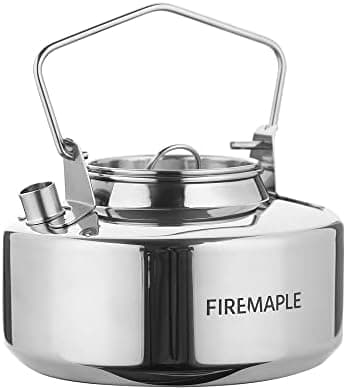
Stainless steel kettles like the Fire-Maple Antarcti and CAMPINGMOON SW-6 are explicitly designed for open-flame and coal use. Most titanium and hard-anodized aluminum kettles are intended for canister and liquid-fuel stoves; reviewers note that prolonged direct-flame use can discolor titanium and damage the anodizing on aluminum models.
Are whistling kettles worth it for camping?
A whistle is genuinely useful around a busy camp or campfire where you're not watching the stove. The tradeoff reviewers flag is extra weight, a spout cap that can rattle loose in a pack, and some models that whistle weakly at altitude. Ultralight backpackers generally skip them; car campers and family campers tend to like them.
How much does weight really matter?
For car camping, almost not at all, optimize for capacity, durability, and how the kettle pours. For backpacking, the gap between a ~120g titanium kettle and a ~250g stainless model adds up quickly over miles, which is why specialist ultralight communities heavily favor titanium or thin hard-anodized aluminum.