
VerdictAI

Reviewer consensus · 2026

Best Survival / Bushcraft Knives of 2026What 45 reviewers actually think, trust-weighted

Survival and bushcraft knives are a category where price tells you surprisingly little about real-world performance, the Scandinavian budget classics keep beating premium tactical-looking blades in side-by-side reviews. We synthesized expert write-ups, specialist-community threads on r/Bushcraft and r/Morakniv, and verified-purchase reviews across the candidate pool to surface the picks that consistently earn praise from people who actually carve wood, baton kindling, and strike ferro rods. Disagreements between mainstream tech press and specialist communities are surfaced honestly rather than smoothed over.

Sources behind this verdict

45 reviewers, weighted by source trust

45reviewers read

Weighted by source trust

We don’t review products. We read what other reviewers wrote, score each source for trustworthiness, and synthesize the consensus.

How sources are scored →

Trust hierarchy

Trusted4
Verified0
Supporting10
Flagged0

Source mix

45signals
  • 28Community
  • 17Video

Trusted · 4 sources

Independent · documented methodology

At a glance

Highest-rated by the consensus

#1 of 5
Top pick · #1Morakniv Companion Fixed Blade Outdoor Knife with Stainless Steel Blade, 4.1-Inch, Orange (M-11824)
Best overall

Morakniv Companion Fixed Blade Outdoor Knife with Stainless Steel Blade, 4.1-Inch, Orange (M-11824)

Morakniv

★★★★★4.8(19,056)92Excellent

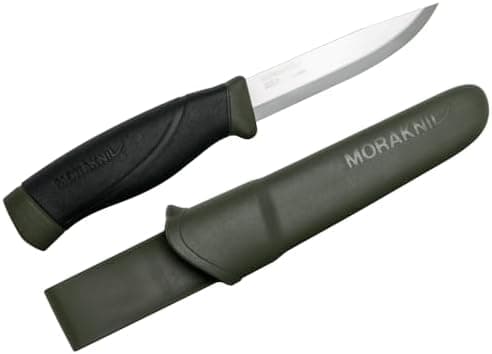
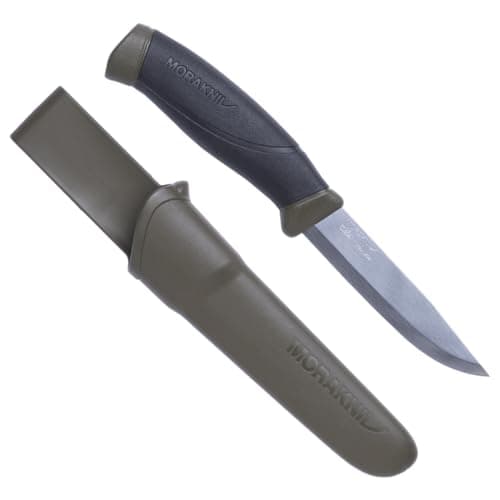
Across the reviewers we read, the Morakniv Companion is the most-recommended entry point into bushcraft knives by a wide margin. gearjunkie.com highlights the 4.1-inch drop-point as nimble enough for finesse tasks like feathering tinder, and trailspace.com calls it 'an excellent outdoor knife at an extraordinary price.' The r/Bushcraft and r/Morakniv consensus is consistent: light, comfortable, easy to sharpen thanks to the Scandi grind, and durable enough that most users keep theirs for years.

The rest of the rankings

#2,5

Frequently asked

5 questions
Do I need a full-tang knife for bushcraft?
It's a real debate. Specialist subreddits including r/Bushcraft and r/Morakniv repeatedly point out that Morakniv's partial-tang knives have held up to decades of hard use, with one r/Bushcraft commenter noting they've seen more full tangs break than partial-tang Moras. Full tang adds strength for heavy batoning and prying, but for carving, feathersticks, and general camp work, a quality partial-tang Scandi-grind knife is widely considered sufficient.
Carbon steel or stainless for a bushcraft knife?
Carbon steel (like the Sandvik used in the Mora Companion HD and Bushcraft Black) sharpens more easily in the field and holds a keen edge, but it will patina and rust if neglected. Stainless is more forgiving for wet environments and beginners. Reviewers across the candidate pool consistently recommend carbon for dedicated bushcraft use and stainless for paddlers or humid climates.
Is a Scandi grind really better for wood carving?
For carving, feathersticks, and controlled wood removal, yes, the Scandi grind is the consensus pick across specialist communities. It bites into wood predictably and is the easiest grind to maintain freehand on a stone. Reviewers note that for food prep or general slicing it's less ideal than a flat or convex grind.
Do I need a knife with a built-in firesteel?
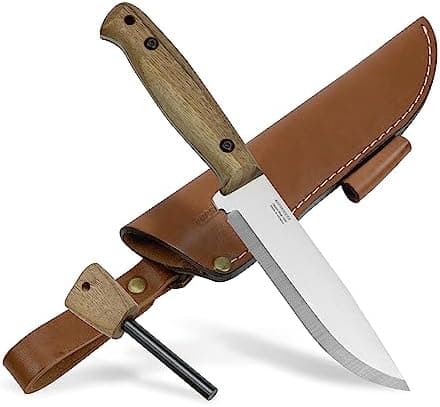
It's convenient but not essential. What matters more is a sharp 90-degree spine that can throw sparks from a separate ferro rod, a feature called out on the Mora Bushcraft Black, BPS Adventurer, and BeaverCraft BSH4F. A separate, larger ferro rod is generally easier to use than the small rods bundled with sheaths.
Are sub-$50 bushcraft knives actually good, or do I need to spend more?
Specialist-community consensus on r/Bushcraft is striking: the budget Scandinavian and Ukrainian options (Morakniv, BPS, BeaverCraft) are regularly described as punching far above their price, with multiple threads calling Moras 'a $20 knife with the quality of a $60 knife.' Premium custom knives offer better steels and fit-and-finish, but performance for typical bushcraft tasks is well-served under $50.