
VerdictAI

Reviewer consensus · 2026

Best Wine Coolers of 2026What 0 reviewers actually think, trust-weighted

Wine coolers span everything from countertop 8-bottle units to 200-bottle built-in cellars, and the right pick depends heavily on capacity, single- versus dual-zone temperature control, and whether you need built-in clearance. The candidates we reviewed surfaced limited independent lab or expert coverage, so this synthesis leans primarily on verified-purchase rating patterns from major-retailer customers rather than on first-party testing. We've weighted review volume alongside star averages and flagged where the evidence base is thin.

At a glance

Compare

Pick any two for a head-to-head

Scores, pros, cons, and our verdict — side by side.

vs

Highest-rated by the consensus

#1 of 7
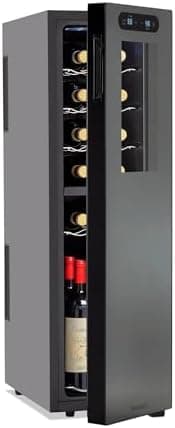
Top pick · #1Wine Enthusiast 18-Bottle Slimline Dual Zone Wine Cooler - Energy Efficient Freestanding Wine Refrigerator…
Best overall

Wine Enthusiast 18-Bottle Slimline Dual Zone Wine Cooler - Energy Efficient Freestanding Wine Refrigerator…

Wine Enthusiast

★★★★★4.5(555)79Good

Across the verified-purchase reviewers we read, this 18-bottle slimline Wine Enthusiast unit earns one of the more reassuring profiles in the category, with a 4.5-star average over 555 ratings, a healthy enough volume to take the average seriously. Buyers favor it for the slim footprint, dual-zone control and digital touchscreen, which make it a sensible default for shoppers who want both reds and whites held separately without committing to a large cabinet.

The rest of the rankings

#2,7

Frequently asked

5 questions
Do I need a single-zone or dual-zone wine cooler?
A single-zone cooler holds everything at one temperature and is fine if you mostly store one style of wine or use it as a beverage chiller. A dual-zone unit lets you keep reds (typically warmer, around 55-65°F) and whites or sparkling (cooler, around 45-50°F) at the same time. Several dual-zone units in this roundup, including the Yeego, Kalamera and Wine Enthusiast models, target buyers who want to serve both at the right temperature.
Can a freestanding wine cooler be built into cabinetry?
Only if the manufacturer explicitly rates it for built-in installation with front-venting. Many models in this list (Yeego, ORYMUSE, Ca'Lefort, the FoMup and the 200-bottle dual-zone unit) advertise built-in or under-counter capability, but freestanding-only units vent from the back or sides and can overheat if enclosed. Always confirm the venting direction before installing flush.
How many bottles do I actually need?
Rated bottle counts assume standard Bordeaux bottles laid flat, so real-world capacity drops once you mix in Burgundy, Champagne or oddly shaped bottles. If you're starting out, a 12-25 bottle countertop unit is usually enough; serious collectors gravitate to the 52-, 180- or 200-bottle cellars, though those numbers are best treated as optimistic maximums.
Are wine coolers quiet enough for a kitchen or living room?
Compressor-based coolers (most units here) are more effective at holding low temperatures than thermoelectric models but produce a periodic hum and faint vibration. Many listings advertise low-noise or quiet operation, but independent noise measurements were not available in the sources we reviewed, so verified-purchase feedback is the best guide on this point.
Why are the scores here capped lower than on other VerdictAI roundups?
This subcategory surfaced very little independent expert or specialist-community testing in our sources. Most of the signal comes from Amazon verified-purchase ratings, which are useful but gameable and don't substitute for lab measurement. We've kept scores moderate to reflect that thinner evidence base rather than implying a level of validation we couldn't confirm.