
VerdictAI

Reviewer consensus · 2026

Best Bike Pumps of 2026What 80 reviewers actually think, trust-weighted

Bike pumps span everything from heavy steel floor pumps that live in the garage to pocketable electric inflators for roadside flats, and the consensus across the reviewers we read is that the right pick depends heavily on how and where you'll use it. We synthesized verified-purchase reviews, independent test labs, mainstream cycling press and specialist subreddits like r/cycling and r/MTB to weigh durability, gauge accuracy, valve handling and real-world inflation speed. Rather than crown a single winner, this roundup maps the trust-weighted consensus onto distinct use cases, from high-pressure road floor pumps to ultralight electric inflators.

Sources behind this verdict

80 reviewers, weighted by source trust

80reviewers read

Weighted by source trust

We don’t review products. We read what other reviewers wrote, score each source for trustworthiness, and synthesize the consensus.

How sources are scored →

At a glance

Compare

Pick any two for a head-to-head

Scores, pros, cons, and our verdict — side by side.

vs

Highest-rated by the consensus

#1 of 8
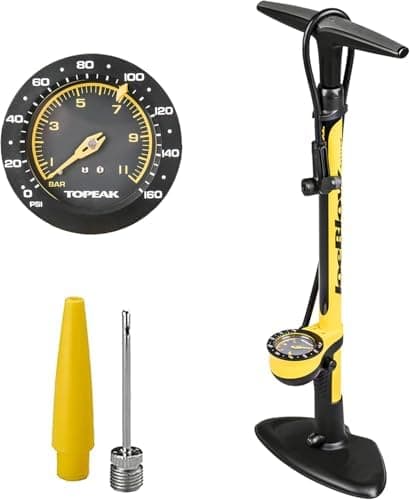
Top pick · #1Topeak JoeBlow Sport III High-Pressure Bike Floor Pump – 160 PSI, Durable Steel Barrel, 3” Analog Gauge…
Best overall floor pump

Topeak JoeBlow Sport III High-Pressure Bike Floor Pump – 160 PSI, Durable Steel Barrel, 3” Analog Gauge…

Topeak

★★★★★4.7(5,553)90Excellent

Across the reviewers we read, the Topeak JoeBlow Sport III is the most consistently recommended full-size floor pump in this pool. outdoorgearlab, a high-trust test lab, places the JoeBlow family among the worthy contenders for an easy-to-read dial, while road.cc handed a sibling model a 9/10 calling it a well-made, easy-to-use pump, and cyclingnews and cyclist.co.uk describe it as a reliable, sturdy everyday track pump.

The rest of the rankings

#2,8

Frequently asked

5 questions
Do I need a floor pump if I already have a mini or electric pump?
Across r/cycling and r/bicycling threads, the strong consensus is yes: a full-size floor pump is far faster and easier for maintaining daily ride pressure, while mini and electric pumps are best reserved for roadside flats and trailside top-ups. Many riders own both, using the floor pump at home and a compact pump in their saddle bag.
What's the difference between Presta and Schrader, and will these pumps fit both?
Presta is the thin valve common on road and higher-end bikes; Schrader is the wider automotive-style valve. Every pump in this roundup is advertised as dual-compatible, and reviewers single out smart or twin-valve heads (like BV's reversible head and Topeak's TwinHead) for switching without leaks or fiddling.
Are electric mini pumps reliable enough to replace a hand pump?
Community sentiment is cautiously positive. Verified-purchase and r/cycling reviewers say electric inflators handle one to three tires per charge and are great for top-ups, but flag inconsistent battery gauges and noise. Several riders still carry a manual backup for longer rides where recharging isn't an option.
How much should I spend on a bike pump?
Specialist-community consensus on r/cycling is that there are steep diminishing returns past roughly $40-50 for a floor pump, and that a sturdy mid-priced model with an accurate gauge covers most riders. Budget floor pumps work well if they're well-built; very cheap pumps are the ones most likely to leak or fail.
Can a portable pump actually reach road-bike pressures like 100 PSI?
Reviewers report that quality mini hand pumps can reach 100 PSI but require patience and many strokes, while compact electric units advertise 100-120 PSI top-ups. For repeatable high-pressure inflation, the reviewers we read overwhelmingly prefer a floor pump.