
VerdictAI

Reviewer consensus · 2026

Best Fastener Assortment Sets of 2026What 22 reviewers actually think, trust-weighted

Fastener assortment kits live or die on three things: whether the sizes you actually reach for are included, whether the case keeps them organized after the first opening, and whether the steel itself holds up to a real driver. Across the reviewers we read, the consensus is that most Amazon-channel kits punch above their price for casual DIY use, but specialist communities push back hard on grade and sorting once you get into structural work. The synthesis below weights verified-purchase volume, mainstream tech and trade coverage, and specialist subreddit pushback to surface picks for distinct use cases rather than a single winner.

Sources behind this verdict

22 reviewers, weighted by source trust

22reviewers read

Weighted by source trust

We don’t review products. We read what other reviewers wrote, score each source for trustworthiness, and synthesize the consensus.

How sources are scored →

Trust hierarchy

Trusted2
Verified0
Supporting6
Flagged0

Source mix

22signals
  • 17Community
  • 5Video

Trusted · 2 sources

Independent · documented methodology

At a glance

Highest-rated by the consensus

#1 of 5
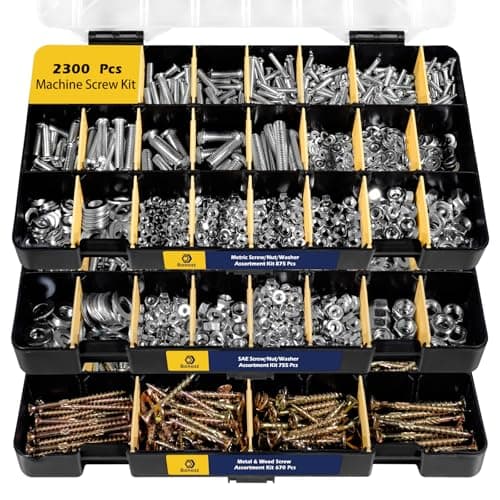
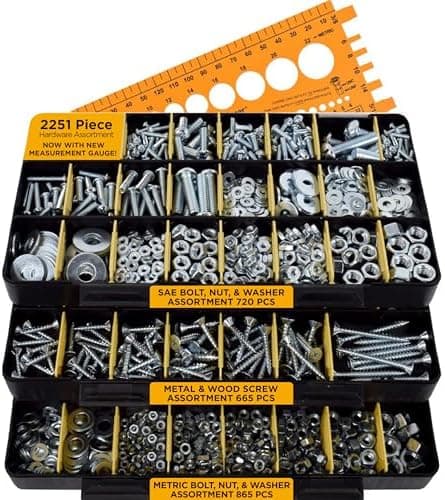
Top pick · #1Jackson Palmer 2251 Piece Hardware Assortment Kit with Screws, Nuts, Bolts & Washers (3 Trays)…
Best overall

Jackson Palmer 2251 Piece Hardware Assortment Kit with Screws, Nuts, Bolts & Washers (3 Trays)…

Jackson Palmer

★★★★★4.6(8,444)84Great

Across the reviewers we read, this Jackson Palmer 2,251-piece kit is the most consistently recommended general-purpose fastener assortment in the pool. The amazon.com listing and walmart.com product page both document the same spec — 62 sizes spanning wood screws, sheet metal screws, metric and SAE bolts, nuts, and washers across three stackable trays — and verified-purchase volume is by far the largest of any candidate here at over 8,400 ratings averaging 4.6 stars.

The rest of the rankings

#2,5

Frequently asked

5 questions
Should I buy a metric-only, SAE-only, or combo fastener assortment?
It depends on what you work on. Across r/Tools and r/3Dprinting threads, the consensus is that 3D printing, electronics, and most modern consumer goods use metric (M2–M6), while older American vehicles, appliances, and US-built furniture lean SAE (#6-32, #8-32, #10-24, 1/4-20). If you do general home DIY, a combo kit is usually the better value; if you only service one ecosystem, a single-standard kit gives you more pieces of the sizes you actually use.
Are Amazon fastener kits good quality or should I order from a specialist?
Mainstream reviewers and specialist subreddits split on this. Verified-purchase volume on the popular Amazon kits is enormous and r/3Dprinting threads concede they're a real deal for the price. But r/Tools and garage forums consistently recommend Bolt Depot or rural farm-supply bulk for anything load-bearing, because Amazon kits are typically Grade 2 or unmarked and not suitable for structural or safety-critical applications.
How many pieces do I actually need in a fastener kit?
More pieces is not automatically better. Specialist communities point out that big 2,000+ piece kits often pad the count with sizes you'll never use. A 300–800 piece kit covering the 6–8 sizes you actually reach for is frequently more useful than a 3,000-piece kit with thin coverage per size.
What's the difference between Grade 2, Grade 8.8, and Grade 10.9/12.9 in these kits?
It's a hardness and tensile-strength rating. Grade 2 is mild steel and fine for cabinetry, electronics, and 3D printing. Grade 8.8 is the metric equivalent of US Grade 5, common for automotive use. Grade 10.9 and 12.9 are higher-tensile alloy steel for high-load applications. Several listings here call out 10.9 or 12.9 alloy steel — that's the spec to verify if you're using these on anything stressed.
Are stainless-steel fastener kits worth the premium?
For outdoor, marine, or wet-area work, yes — 304 stainless resists corrosion far better than zinc-plated carbon steel. But r/Tools community consensus is that stainless is mechanically weaker than equivalent grade-rated alloy steel, so it's the wrong choice if you need clamping force or shear strength.