
VerdictAI

Reviewer consensus · 2026

Best Wet Tile Saws of 2026What 44 reviewers actually think, trust-weighted

Wet tile saws span everything from $89 tabletop units for a single bathroom to $1,500+ contractor rigs that handle 24-inch porcelain slabs. This roundup synthesizes what mainstream tool reviewers, retailer verified-purchase reviewers, and specialist tile-trade communities (notably r/Tile) have said about the current field, weighted by source trust. We don't test saws ourselves; we summarize the consensus and flag where reviewers disagree.

Sources behind this verdict

44 reviewers, weighted by source trust

44reviewers read

Weighted by source trust

We don’t review products. We read what other reviewers wrote, score each source for trustworthiness, and synthesize the consensus.

How sources are scored →

Trust hierarchy

Trusted2
Verified0
Supporting11
Flagged0

Source mix

44signals
  • 24Community
  • 20Video

Trusted · 2 sources

Independent · documented methodology

At a glance

Highest-rated by the consensus

#1 of 5
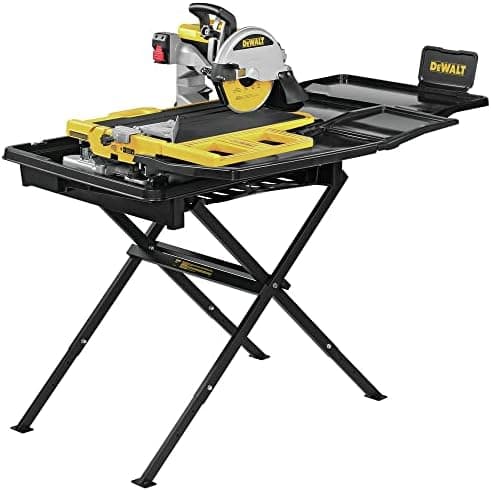
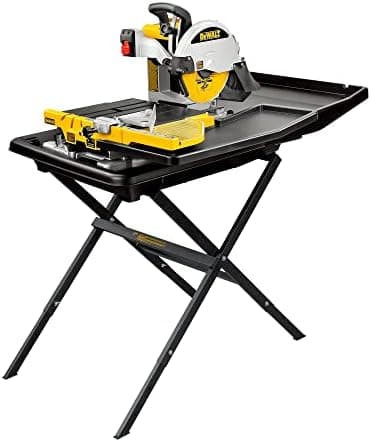
Top pick · #1DEWALT Wet Tile Saw with Stand, 10-Inch, Corded (D24000S)
Best overall

DEWALT Wet Tile Saw with Stand, 10-Inch, Corded (D24000S)

★★★★★4.7(823)91Excellent

Across the reviewers we read, the DeWalt D24000S is the default recommendation for a serious portable wet tile saw. homedepot.com verified-purchase reviewers describe standard cuts as 'easy, accurate, and clean' with sturdy rails producing repeatable results, and r/Tile threads consistently call it 'fairly light, easy to transport, and versatile enough to make lots of intricate cuts.' One long-time installer on r/Tile with 40 years in the trade flatly called it the best tile saw they've ever used.

The rest of the rankings

#2,5

Frequently asked

5 questions
How many amps do I need in a wet tile saw?
For occasional DIY work on ceramic and small-format porcelain, a 4–7 amp 7-inch saw is generally adequate. For large-format porcelain (12x24 and up) or daily pro use, reviewers across r/Tile consistently recommend a 10-inch, 15-amp saw such as the DeWalt D24000 or D36000 class. Underpowered saws struggle with dense porcelain and burn blades faster.
Is the DeWalt D24000 or D36000 better?
Both share the same motor. The D36000 adds rip and crosscut capacity and a larger cast-aluminum tray, but is roughly 20 pounds heavier and bulkier to transport. Specialist subreddit threads on r/Tile are genuinely split — some installers regret upgrading and prefer the lighter D24000, while others value the extra capacity for large-format tile. Choose by tile size and how often you move the saw.
Can a cheap 7-inch tabletop wet saw handle a full bathroom?
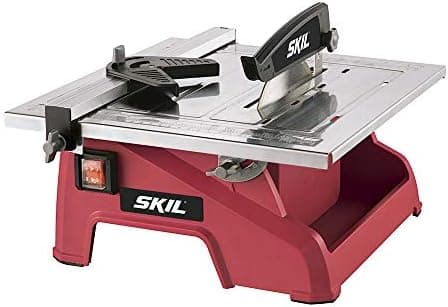
Verified-purchase reviewers on Home Depot and Lowes, plus long-time owners on r/HomeImprovement, report finishing multiple bathroom jobs with a sub-$100 SKIL-class saw. The trade-offs are limited cut capacity, less accurate fences, and slower cutting on dense porcelain. For a single renovation it's usually adequate; for repeat work, reviewers steer toward a 10-inch saw.
Do I need a stand for a wet tile saw?
For 10-inch saws like the DeWalt D24000S and D36000S, the matching stand is generally considered worth it by r/Tile users because the saw is heavy and the stand integrates water management. For 7-inch tabletop saws, a sturdy work table is usually sufficient.
What blade should I use with a wet tile saw?
Across r/Tile threads, continuous-rim diamond blades from DeWalt, Rubi, MK Diamond, and similar specialist brands get the most praise for chip-free cuts on porcelain. The blade included with budget saws is generally fine for ceramic but reviewers recommend upgrading for porcelain or natural stone.