
VerdictAI

Reviewer consensus · 2026

Best Electric Pressure Washers of 2026What 68 reviewers actually think, trust-weighted

Electric pressure washers have become the default choice for homeowners who want gas-level cleaning without the maintenance, and the field is crowded with Westinghouse, Greenworks, and Sun Joe models plus a wave of generic high-PSI listings. This roundup synthesizes what testing-focused publishers, verified-purchase reviewers, and specialist communities like r/AutoDetailing and r/pressurewashing have already written, weighted by source trust. We deliberately set aside the flood of "4800–5000 PSI" no-name listings whose specs reviewers and engineers in the data repeatedly flag as inflated, and concentrate on models with real testing and review depth.

Sources behind this verdict

68 reviewers, weighted by source trust

At a glance

Compare

Pick any two for a head-to-head

Scores, pros, cons, and our verdict — side by side.

vs

Highest-rated by the consensus

#1 of 7
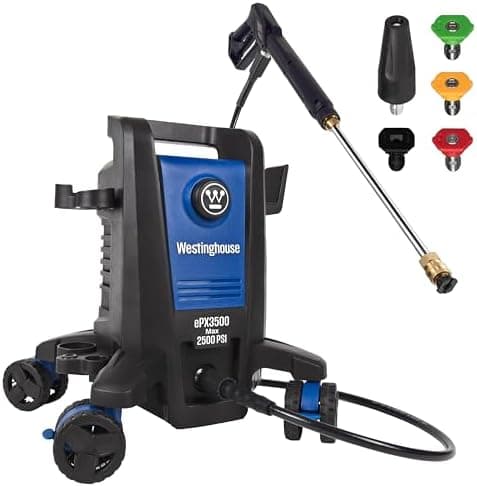
Top pick · #1Westinghouse ePX3500 Electric Pressure Washer, 2500 Max PSI 1.76 Max GPM with Anti-Tipping Technology…
Best overall

Westinghouse ePX3500 Electric Pressure Washer, 2500 Max PSI 1.76 Max GPM with Anti-Tipping Technology…

★★★★★4.6(12,168)86Great

Across the reviewers we read, the Westinghouse ePX3500 lands as the most well-rounded electric pick: it pairs a 2500 max PSI / 1.76 max GPM rating with a four-wheel chassis, onboard soap tank, and steel wand at a price that verified-purchase reviewers on Amazon and Home Depot repeatedly call a strong value. Home Depot's review aggregation summarizes it as "a great value for its price" and a popular homeowner choice, and the r/carverscave write-up highlights the auto-stop pump that cuts power when you release the trigger.

The rest of the rankings

#2,7

Frequently asked

5 questions
How much PSI do I actually need in an electric pressure washer?
Across the reviewers and specialist communities we read, the consensus is that 2000–3000 PSI covers nearly all home tasks: cars, siding, fences, decks, and driveways. Community threads (notably r/pressurewashing and r/Tools) repeatedly warn that PSI claims above ~3400 on consumer electric units are often marketing rather than measured output, and that flow rate (GPM) matters as much as PSI for how fast you finish a job.
Are electric pressure washers powerful enough compared to gas?
Reviewers agree electric models clean nearly everything a homeowner needs, but specialist communities note that electrics push less water (lower GPM) than gas, so large surfaces take longer. The trade-off is instant push-button start, no fuel or carburetor upkeep, lighter weight, and quieter operation.
Should I trust those 5000 PSI listings on Amazon?
Be skeptical. The generic high-PSI units in this category tend to have thin review counts, and engineers and testers in the source threads (r/Tools, r/pressurewashing) point out that the physics of consumer electric motors make true 4800–5000 PSI output implausible at the listed price and flow. We discounted those listings heavily in favor of models with documented testing.
What's the best electric pressure washer for washing cars?
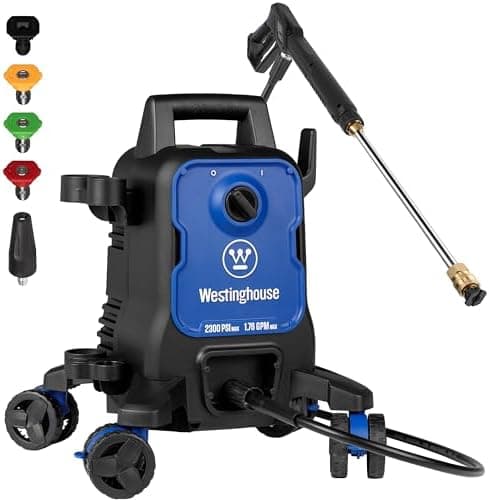
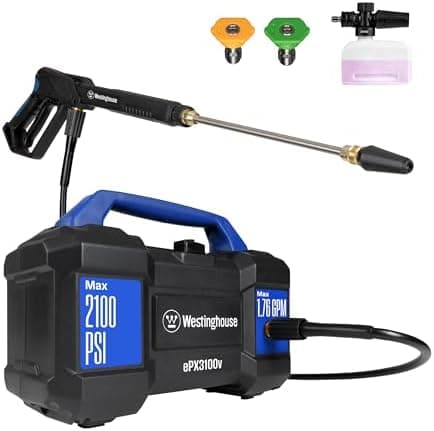
Detailing-focused reviewers in r/AutoDetailing repeatedly point to the lower-PSI Westinghouse ePX line (around 2100–2300 PSI) on four wheels, because the wheeled chassis is easy to pull around a vehicle and the pressure is gentle enough to avoid paint damage while still powering a foam cannon.
Do I need an induction motor or is a universal motor fine?
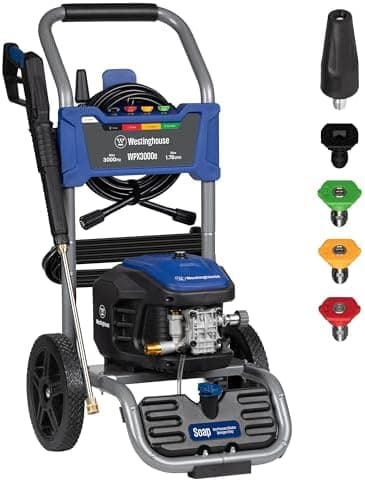
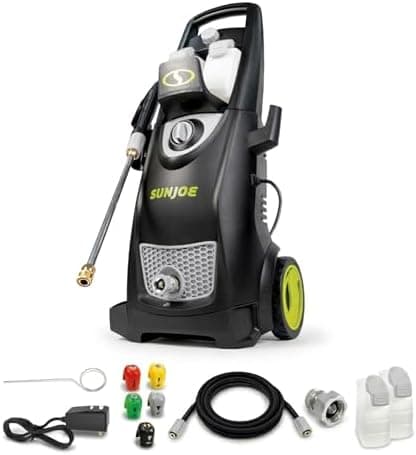
Induction motors (found on models like the Westinghouse WPX3000e) run quieter and tend to last longer than the universal motors in most budget units, according to community discussion. For occasional homeowner use, universal-motor units like the Sun Joe SPX3000 still earn strong long-term satisfaction; for frequent use, reviewers lean toward induction or brushless designs.